
Virginia City is a small town with a big name. The historic Comstock mining town sits at about 6,200 feet in Storey County, and most people who ask about moving there know its main street before they know anything about living in it. This guide is about the second part: what a house costs, what the county bills you every month, how homes are heated, what the historic district allows, and what winter, wildfire and medical care look like from town.
The housing figures are our own. We pulled every house sale the Northern Nevada Regional MLS recorded for the town, MLS city Virginia City in ZIP 89440, from October 1, 2023 through September 30, 2026, plus the listings and rental records on November 16, 2026. It is a small market, and we say so wherever a number rests on a handful of sales. The newer homes on acreage in the hills, Virginia City Highlands, are a different market with their own Highlands guide; this one stays in town.
Eight houses sold in historic Virginia City from October 2025 to September 2026, at a $507,000 median and $297 a square foot, per the Northern Nevada Regional MLS. The MLS lists no rentals in town. County water and sewer cost at least $108.96 a month and a trash cart $26.68. Propane is the most common heating fuel, and sellers' median tax bill was $2,300 a year.
- Eight town houses sold in the 12 months to September 2026, at a $507,000 median.
- The MLS feed holds no lease record for the town, so finding a rental takes local legwork.
- Storey County water and sewer start at $108.96 a month; trash adds $26.68.
- Census estimates show no households on utility gas; propane heats about four in ten.
- Exterior changes in the Comstock Historic District need a state certificate of appropriateness.
What Does a House in Virginia City Cost?
| Measure | 12 months to September 2026 | 36 months to September 2026 |
|---|---|---|
| House sales | 8 | 17 |
| Median sale price | $507,000 | $474,000 |
| Price range | $378,226 to $755,000 | $125,000 to $2,300,000 |
| Median price per square foot | $297 | $297 |
| Median size | 1,635 sq ft | 1,770 sq ft |
| Median days from listing to accepted offer | 23.5 | 33 |
| Sold below original asking price | 5 of 8 | 12 of 17 |
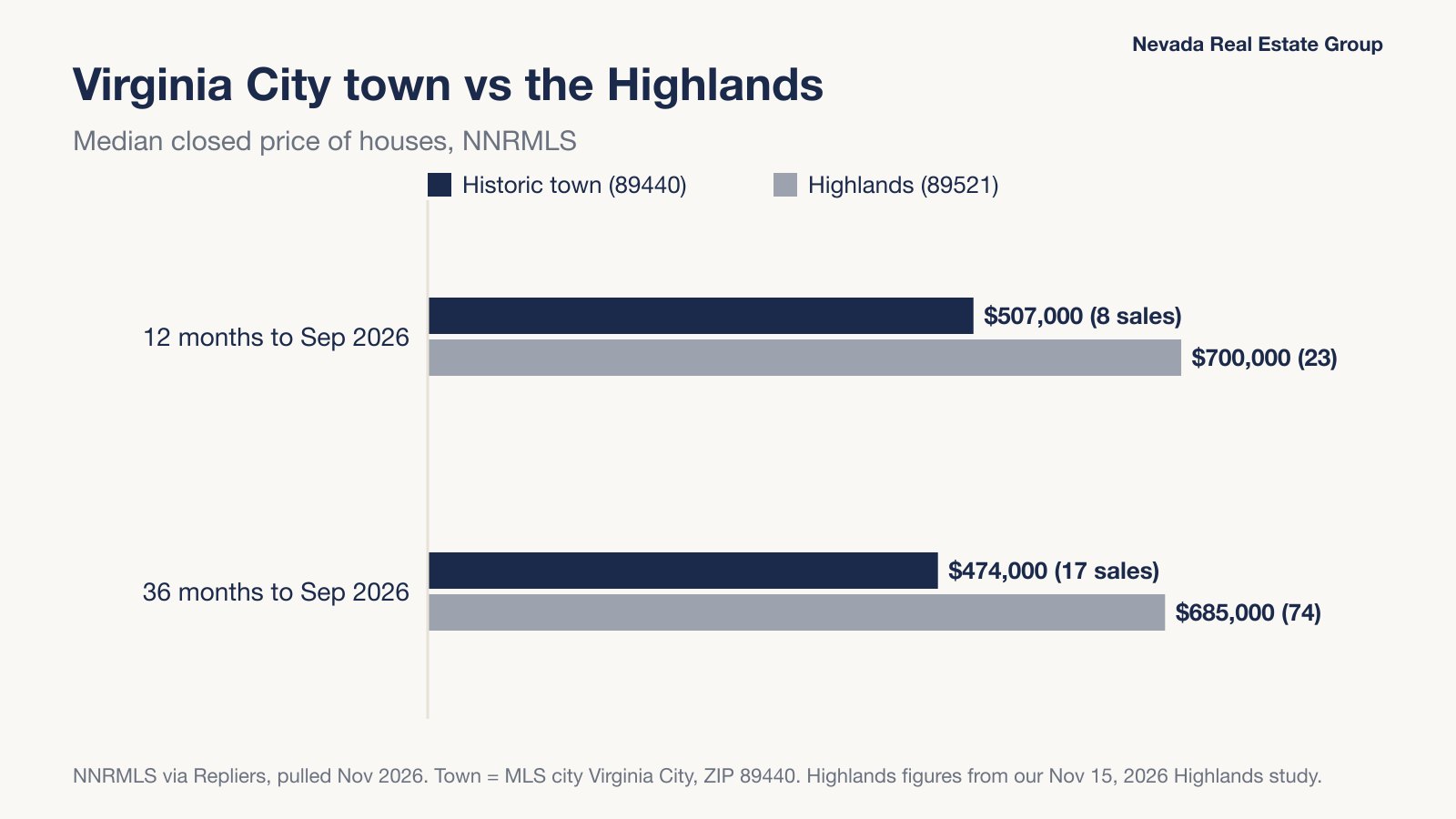
A house in town cost a median $507,000 in the 12 months to September 2026, but that figure rests on eight sales, so read it as a range more than a price. The eight sold between $378,226 and $755,000, the middle four between $440,000 and $540,000, and the median works out to $297 a square foot for about 1,635 square feet on a quarter-acre town lot. Over three years, 17 houses sold at a $474,000 median. No condos, townhomes or manufactured homes sold in town in those three years; every home sold was a detached house.
The pace was steady but not fast. Half the 2025-26 sales went under contract within nine days of listing, while the rest took one to three months. Five of the eight closed below their original asking price, and the median sale closed at 98.4% of its final list price. On November 16, 2026, seven houses were listed in town at a median ask of $625,000, and five of the six still available had already cut their price. Asking prices above recent sales and frequent cuts are typical of a market this thin, where each listing is priced against very few comparable sales.
For a buyer, the practical lesson is that one sale can move the median by tens of thousands of dollars, so price a specific house against the closest sales by size, age and street, not against the town median. Our Virginia City community page shows what is for sale now, and our Northern Nevada communities page covers the towns around it.
How Is the Historic Town Different From Virginia City Highlands?
| Measure | Historic town (ZIP 89440) | Highlands (ZIP 89521) |
|---|---|---|
| House sales | 8 | 23 |
| Median sale price | $507,000 | $700,000 |
| Median price per square foot | $297 | $320 |
| Median size | 1,635 sq ft | 2,378 sq ft |
| Median lot | About 0.25 acre | About 3.5 acres |
| Water and sewer | County public water and sewer, all 8 sales | Private wells and septic |
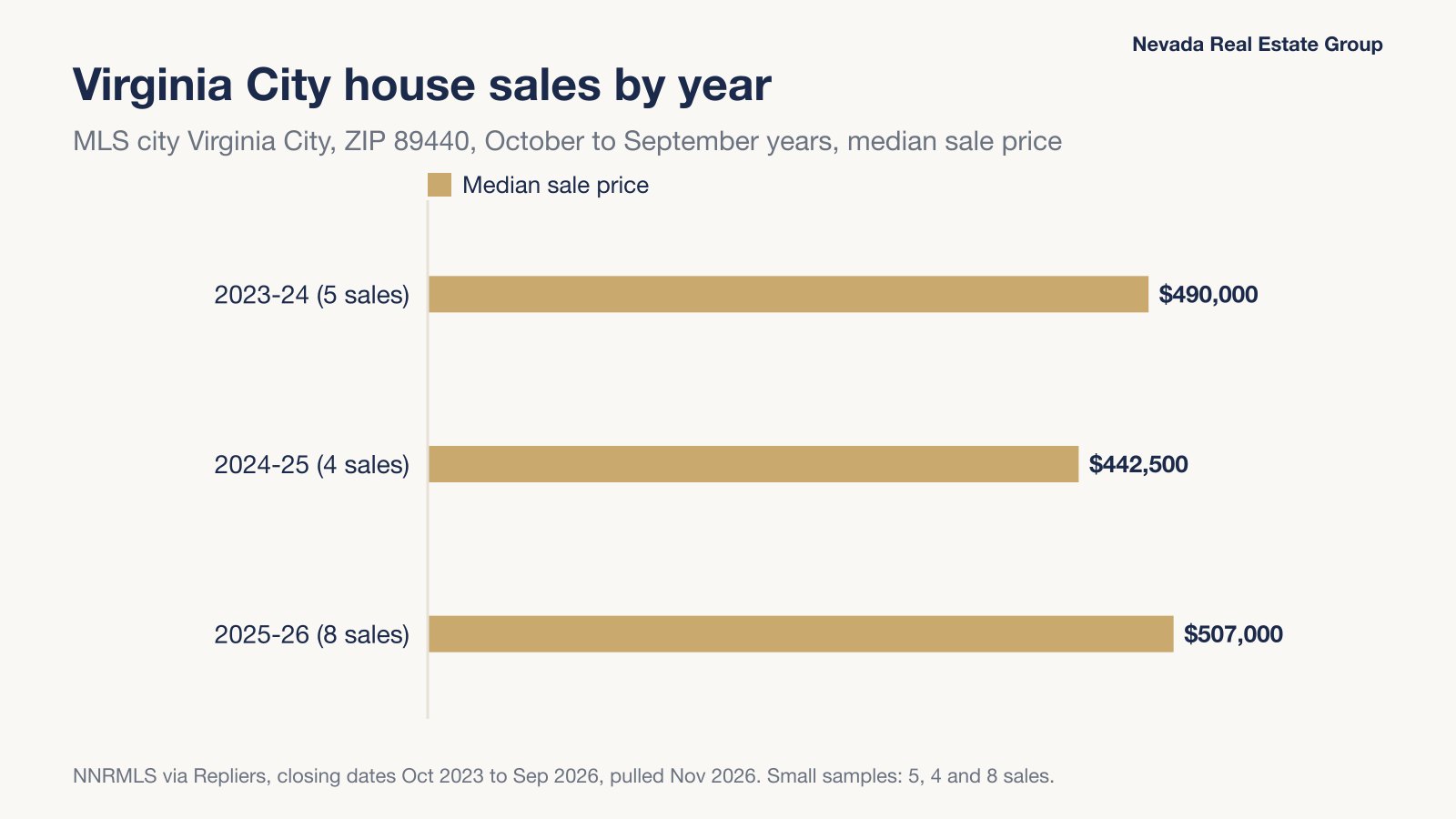
People say "Virginia City" for two different places, and they are different purchases. The historic town is a grid of streets on the side of Mount Davidson, with houses on small lots served by Storey County's public water and sewer. Virginia City Highlands is a subdivision of larger homes on acreage in the hills to the north, most of it with Reno 89521 mailing addresses, wells and septic systems. Both are in Storey County and share its tax rate, but almost everything else about owning differs.
In the 12 months to September 2026, Highlands houses sold for a median $700,000 on 23 sales, about $193,000 above the town's $507,000. Measured per square foot the two are close, $320 against $297, so most of the gap is size and land: the typical Highlands house sold in those 12 months was about 2,378 square feet on about 3.5 acres, against about 1,635 square feet on a quarter acre in town.
Which fits depends on what you need, not on which is better. Town living means walking-distance services and county water and sewer, with historic-district rules and the visitors that come with a tourist main street. The Highlands means space and privacy, with a well, a septic system and private roads to maintain. Our Highlands guide covers wells, roads and the Geiger Grade in detail, and the Highlands community page shows its listings.
Can You Rent in Virginia City Before You Buy?
Not through the usual channels. The Northern Nevada Regional MLS feed holds no lease record of any date for ZIP 89440 or the MLS city of Virginia City, and none were active on November 16, 2026. The same query on ZIP 89521 returned 104 lease records, all on the Washoe County side of that ZIP, so the search itself works; rentals in town simply are not listed through agents on the MLS.
Rentals do exist. The 2020 Census counted 120 renter-occupied homes among 388 occupied homes in the Virginia City census-designated place, about 31%. The later 2020–2024 American Community Survey shows no renter households, but with a margin of error of 14 on a small sample, that zero is a sampling result, not a count. The survey could not compute a median rent for the town at all, and its county-wide median gross rent, $1,153, carries a margin of $701, too wide to plan with.
So renting first is possible, but it takes local legwork: landlords, property managers and word of mouth rather than an MLS search. If nothing turns up, a short-term stay, a rental in nearby Carson City, Dayton or Reno, or an extended visit across a winter are the alternatives. Our Carson City relocation guide and Dayton relocation guide cover the closest towns with more homes to rent.
What Will Property Taxes Cost in Virginia City?
Storey County has a single property tax rate for the town and the rest of the county. The Nevada Department of Taxation's fiscal 2026-27 rate book puts every Storey County district at 3.4607 per $100 of assessed value, made up of the state, the Storey County School District, Storey County and the Storey County Fire Protection District. On a home with $100,000 of taxable value, that comes to $1,211.25 a year.
That rate does not apply to a sale price. Under NRS 361.225, property is assessed at 35% of its taxable value, and under NRS 361.227 taxable value counts land value and the building's replacement cost less depreciation, usually below what a buyer pays. A better guide is what owners were actually billed: the listings of the eight houses sold in 2025-26 showed a median annual tax of $2,300, about 0.43% of the sale price.
Two cautions for a buyer. First, the bill on a listing is the seller's, built up under the caps, and yours may differ. NRS 361.4723 limits yearly increases on an owner-occupied primary residence to 3%, measured against the property's prior-year tax, but a new owner has to claim that cap; until then the general cap of up to 8% in NRS 361.4722 applies. Second, a historic home with a recent renovation can carry a higher taxable value than its age suggests. Ask the Storey County Assessor for the parcel's current record before you budget.
What Do Water, Sewer and Trash Cost Each Month?
| Charge | Monthly amount |
|---|---|
| Water, first 2,000 gallons | $39.72 |
| Water capitalization fee | $11.24 |
| Water over 2,000 gallons | $3.54 per 1,000 gallons |
| Sewer, first 2,000 gallons | $22.39 |
| Sewer USDA loan repayment | $35.61 |
| Trash, 64- or 96-gallon cart | $26.68 |
| Minimum total | $135.64 |
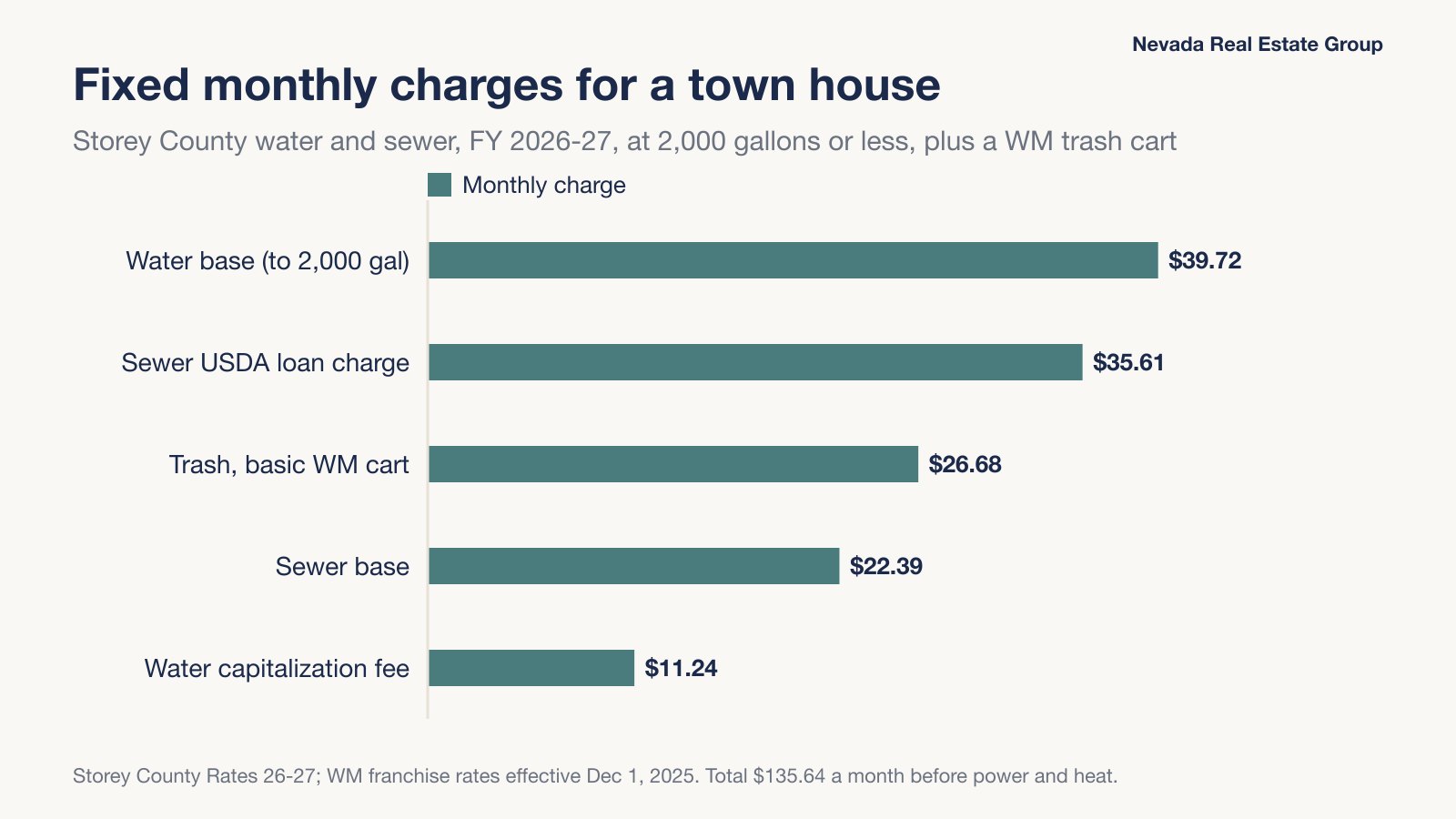
Town homes are on Storey County's public systems, and every one of the 17 town houses sold since October 2023 listed public water and sewer. The county's fiscal 2026-27 rate sheet, linked from its water page, sets a residential water charge of $39.72 for the first 2,000 gallons plus an $11.24 capitalization fee, and a sewer charge of $22.39 plus a $35.61 USDA loan repayment. The Carson Water Subconservancy District's 2026 rate survey lists Storey County's billing as monthly. At 2,000 gallons or less, water and sewer come to $108.96 a month; at 5,000 gallons, about $119.58.
Trash is a franchise with Waste Management. Its rate letter to Storey County set a basic 64- or 96-gallon cart at $26.68 a month from December 1, 2025, with lower senior rates. The franchise allows a yearly inflation adjustment of up to 5%, so a new rate may apply from December 1, 2026. The county's transfer station page says single-family residents get three free dump vouchers a year. Together, water, sewer and a trash cart start at $135.64 a month, before electricity and heating fuel.
If you are building or adding a connection, the county's hook-up fee page listed $2,500 for residential water and $3,300 for sewer on November 16, 2026. For the rest of the move-in checklist, see our Northern Nevada utility setup guide.
How Are Virginia City Homes Heated and Powered?
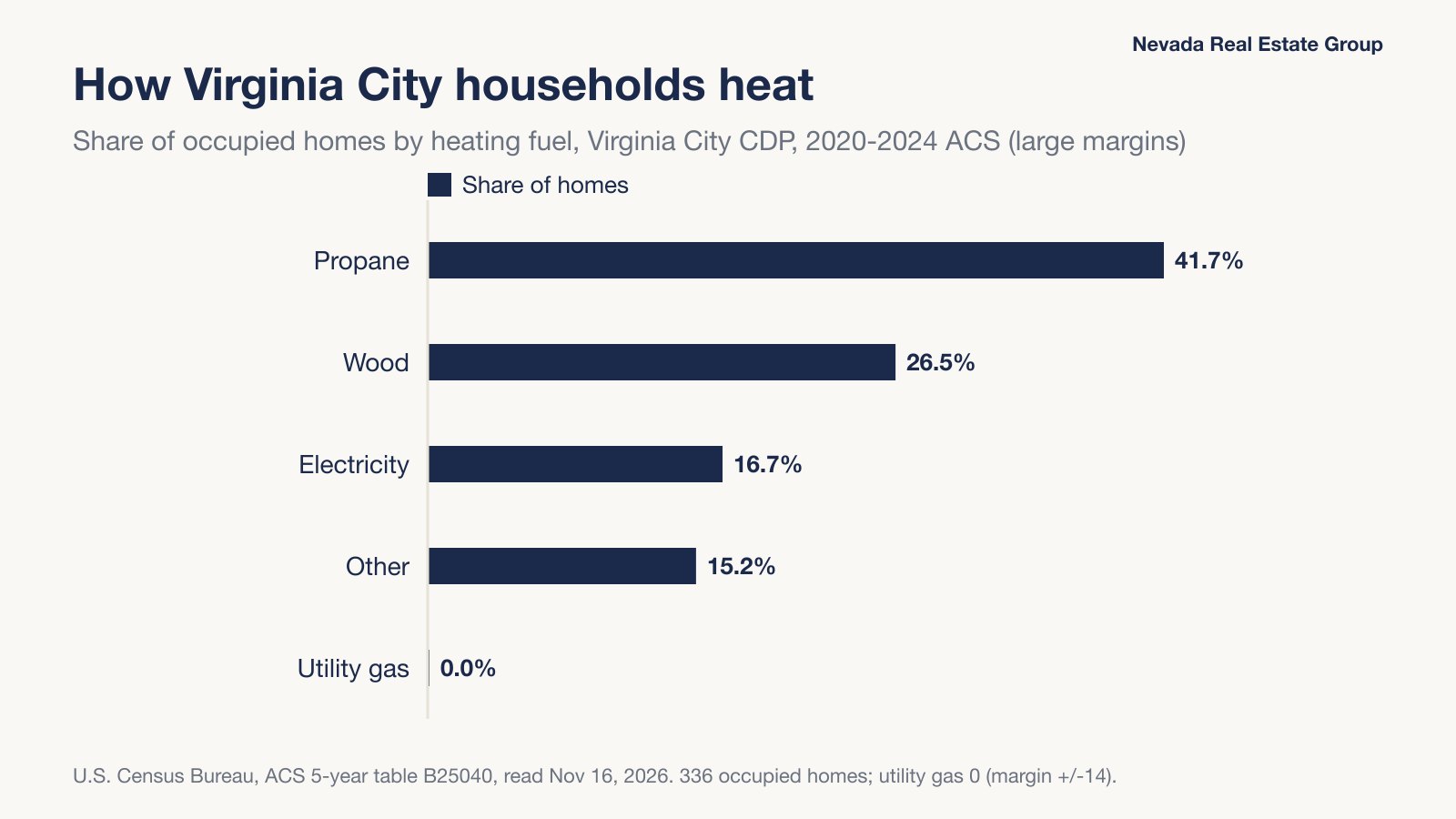
Plan on propane. In the Census Bureau's 2020–2024 heating-fuel estimates for the Virginia City census-designated place, about 41.7% of occupied homes heat with propane, 26.5% with wood, 16.7% with electricity and 15.2% with other fuels, and none with utility gas, with a margin of 14 on that count. The MLS listings tell the same story: 13 of the 17 town houses sold since October 2023 recorded propane heat. One recent listing claimed a natural gas connection, which we could not confirm, so treat utility gas as something to verify for a specific address rather than expect.
Electricity comes from NV Energy; Storey County's residential construction packet directs applicants to NV Energy for electrical service. Propane means a tank, either owned or leased, and a delivery contract, and its cost depends on the supplier, the tank and how much you use. Get the last 12 months of propane and electric bills from the seller before you write an offer; a drafty older house at 6,200 feet can cost far more to heat than its size suggests.
Wood heat is common too, about a quarter of homes in the Census estimate, so check the condition of any stove and chimney during inspection. Our home inspection guide for Northern Nevada buyers covers what to ask an inspector to look at, and older homes deserve a closer look at insulation, windows and the roof.
What Does the Comstock Historic District Mean for Owners?
Virginia City and Gold Hill sit inside the Comstock Historic District, created under Nevada Revised Statutes chapter 384, and that shapes what you can do to a house. Under NRS 384.110, no structure in the district may be erected, reconstructed, altered, restored, moved or demolished until the Comstock Historic District Commission, or its staff, approves an application for a certificate of appropriateness covering the exterior architectural features. Storey County's construction packet says the district generally covers Virginia City and Gold Hill and that the certificate goes in with residential plans.
In practice, that means new windows, siding, a porch, a fence, an addition or a new house all go through design review before work starts, and under NRS 384.190 the Commission's building inspector can order work stopped that goes ahead without approval. Ordinary maintenance or repair that does not change the design, material or outward appearance is exempt under NRS 384.110. Interior work is not what the certificate covers, but the building permit still applies. Build extra time into any renovation plan, and ask the seller what approvals past work received.
The district also limits housing types. NRS 384.100 says that once the district is established, no house trailer, mobile home or recreational vehicle may be placed in it unless the commission and the county agree to a trailer overlay or a mobile home park. That fits the MLS record: no manufactured home sold in town in the three years we checked. If you are thinking of placing one on a lot, confirm whether that lot is inside the district first.
What Are Winters Like at 6,200 Feet?
Virginia City is high. The U.S. Geological Survey's elevation service puts the town core at about 6,204 feet and the fire station on C Street at about 6,167 feet, well above Reno and Carson City. Storey County's construction packet lists a ground snow load of 70 pounds per square foot between 6,000 and 6,499 feet and requires ice-shield underlayment above 5,000 feet, which tells you what the county expects winter to bring.
Getting in and out of town in winter runs on state highways. Storey County's road page says the county maintains county roads and points residents to the Nevada Department of Transportation for road conditions and closures, and Nevada's road-condition definitions include levels from chains or snow tires required to chains on every vehicle except four-wheel drive with snow tires. Check conditions before you drive, and keep chains in the car.
For a household, winter at this elevation means a higher heating bill, a snow plan for the driveway and roof, and some days when you stay home. Steep streets in town add to that. Our guide to snow in the Reno area covers what Northern Nevada winters look like at lower elevations, and the Highlands guide covers the Geiger Grade.
How Serious Is Wildfire Risk in Virginia City?
Officials treat it as high. A February 2026 Bureau of Land Management decision on rebuilding an aging power line in the Virginia City area described the project as being in a high fire-risk area in the wildland-urban interface. An older county wildfire hazard assessment, with field work from about 2004, rated Virginia City in its high hazard category at 75 points and noted that a fire through Six Mile Canyon would block two of the three evacuation routes out of town. That assessment is about 20 years old, so read it for the shape of the risk, not a current score.
The risk shows up in insurance. The Storey County Fire Protection District's homeowners insurance page says residents have faced difficulty maintaining or obtaining homeowners insurance because of wildfire risk assessments, and the district offers courtesy evaluations of defensible space. Get an insurance quote for the specific address early in your search, before you are under contract, and include it in your monthly budget.
Defensible space is the part an owner controls. The district's defensible space program explains clearing vegetation around a home. Our wildfire and home insurance guide for Northern Nevada buyers covers how insurers look at a property and what to ask your agent and insurer.
What Medical Care and Schools Are in Town, and What Is Down the Hill?
Most medical care is out of town. The University of Nevada, Reno School of Medicine's 2025 rural health data book lists Storey County with no licensed community hospital beds. In town, Nevada Health Centers runs the Virginia City Community Health Center at 175 E. Carson Street, open on Thursdays for family medicine, with telehealth on weekdays. Carson Tahoe Regional Medical Center in Carson City provides 24-hour emergency care, and Carson Tahoe lists urgent care clinics in Dayton and Carson City. We have not given drive times because no official page we read states one; check them from the address you are considering.
Emergency medical response comes from the Storey County Fire Protection District, whose station list puts Station 71, the headquarters, at 145 N. C Street in Virginia City with two ambulances. The district sells an ambulance subscription at $75 a year for a single-subscriber household and $125 for two or more, at its listed 2024-25 rates. For anyone who sees specialists regularly, the distance to Carson City or Reno belongs in the decision.
Schools are the exception: they are in town. The Storey County School District's schools page lists Hugh Gallagher Elementary, Virginia City Middle School and Virginia City High School in Virginia City, plus Hillside Elementary, and all 17 town houses sold since October 2023 listed Hugh Gallagher as their elementary school. Storey County's Living in Storey County page describes the district's schools and a total enrollment of over 500 students; that page is undated, so confirm grade spans, programs and the assignment for the exact address with the district before you buy.
What Does a Monthly Budget for a Virginia City House Look Like?
| Line | 10% down | 20% down |
|---|---|---|
| Principal and interest | $3,070 | $2,728 |
| Property tax (sellers' median bill, $2,300 a year) | About $192 | About $192 |
| Water, sewer and trash minimum | $135.64 | $135.64 |
| Known lines, total | About $3,398 | About $3,056 |
| Still to quote | Homeowners insurance, propane, electricity, mortgage insurance below 20% down | |
At Freddie Mac's 7.11% average for the week of November 12, 2026, principal and interest on the $507,000 median house come to about $3,070 a month with 10% down and $2,728 with 20% down. Add about $192 a month for property tax, based on the sellers' median bill, and $135.64 for county water, sewer and trash, and the known lines total about $3,398 and $3,056.
The lines we cannot fill in are the ones that vary most here. Homeowners insurance depends on wildfire risk at the address and can be hard to place. Propane and electricity depend on the house's age, insulation and heating system, and a winter at 6,200 feet is long. Mortgage insurance applies below 20% down. Get an insurance quote and a year of the seller's utility bills before you settle on a budget.
Compared with the Highlands, a town house costs less to buy and adds county utility bills instead of a well and septic system. Compared with Carson City, our Carson City cost-of-living guide shows what the larger town nearby costs. Nevada's lack of a state income tax applies in both.
What Should You Check Before Buying a Home in Virginia City?
Start with the house's history. Ask the seller which exterior work went through the Comstock Historic District Commission, and check any planned changes with the commission before you count on them. Ask whether the property is in Virginia City proper or Gold Hill, which the MLS records under the same Virginia City 89440 address, and confirm with Storey County Public Works that the address is on county water and sewer.
Then check the systems that matter at altitude. Find out how the house is heated, who supplies the propane and whether the tank is owned or leased, and get a year of fuel and electric bills. Have an inspector look closely at the roof, chimney, insulation and any wood stove, and at foundations on the steeper lots. Our radon testing guide for Northern Nevada explains when to add that test.
Finally, check the costs that sit outside the purchase price. Get a homeowners insurance quote for the address, ask the assessor for the parcel's taxable value, and work out your routes to Carson City or Reno for work, shopping and medical care. If you are buying land to build, our guide to buying land around Reno and Sparks covers water and permits, and in town the historic district and county hook-up fees come first.
Frequently Asked Questions
How much does a house cost in Virginia City, Nevada?
Eight houses sold in historic Virginia City from October 2025 to September 2026, at a median $507,000 and $297 a square foot, per the Northern Nevada Regional MLS. They ranged from $378,226 to $755,000. Over three years, 17 houses sold at a $474,000 median. On November 16, 2026, seven houses were listed at a median ask of $625,000.
Is Virginia City the same as Virginia City Highlands?
No. The historic town is a small grid of houses on county water and sewer in ZIP 89440. Virginia City Highlands is a subdivision of larger homes on acreage with wells and septic, mostly with Reno 89521 addresses. Highlands houses sold for a median $700,000 in the same 12 months, against $507,000 in town.
Can you rent a house in Virginia City?
Rentals exist but are not listed on the MLS: the feed has no lease record for ZIP 89440, while the 2020 Census counted 120 renter households in town, about 31% of occupied homes. Ask local landlords and property managers, and if you want to try the area first, plan on a short-term stay or a rental in Carson City, Dayton or Reno.
What are utility costs in Virginia City?
Storey County water and sewer start at $108.96 a month for up to 2,000 gallons under the fiscal 2026-27 rates, and a Waste Management trash cart is $26.68, for $135.64 before power and heat. Electricity is NV Energy. Propane and wood are the most common heating fuels, and Census estimates show no households on utility gas.
What is the property tax rate in Virginia City?
Storey County's rate is 3.4607 per $100 of assessed value for fiscal 2026-27, or $1,211.25 on $100,000 of taxable value. Property is assessed at 35% of taxable value, not the sale price. Sellers of the eight houses sold in 2025-26 were billed a median $2,300 a year.
Can I put a manufactured home on a lot in Virginia City?
Generally not inside the Comstock Historic District. NRS 384.100 bars placing a house trailer, mobile home or recreational vehicle in the district unless the historic district commission and the county agree to a trailer overlay or a mobile home park. No manufactured home sold in town in the three years we checked.
Where do Virginia City residents go for hospital care?
Storey County has no licensed community hospital beds, so hospital care is out of the county. Carson Tahoe Regional Medical Center in Carson City provides 24-hour emergency care, and Carson Tahoe runs urgent care in Dayton and Carson City. A Nevada Health Centers clinic in town is open on Thursdays, and the county fire district runs two ambulances from Virginia City.
Is Virginia City the Right Move for You?
Virginia City suits buyers who want a small, historic town and accept what comes with it: few homes for sale, few listed rentals, county water and sewer bills, propane heat, design review for exterior changes, a long winter at 6,200 feet, real wildfire exposure and medical care down the hill. The numbers are workable: a median house at $507,000 in the latest year, about $135.64 a month in county water, sewer and trash, and a property tax bill that sellers' listings put around $2,300 a year. The harder questions are insurance, heating and access, and those depend on the specific house.
If you are weighing it against nearby towns, our Reno relocation guide and the Carson City and Dayton guides cover the larger markets, and the Highlands guide covers acreage in the hills. In a market with four to eight house sales a year, the most useful thing a buyer can have is the full history of the few comparable homes. If you can, visit in winter as well as summer: the town you see on a July weekend, busy with visitors, is not the one you will live in during a January storm.
Nevada Real Estate Group has closed more than 9,600 transactions worth over $4.85 billion. For the recent sales near a Virginia City house you are considering, call our Northern Nevada team at (775) 277-2120 or contact our team.
Which Sources Inform This Virginia City Guide?
Housing figures are our own pull from the Northern Nevada Regional MLS via Repliers on November 16, 2026: house sales recorded as Closed with an MLS closing date from October 1, 2023 to September 30, 2026, MLS city Virginia City and ZIP 89440, which includes Gold Hill and excludes Virginia City Highlands; listings and lease records as of the same date. Feed records without a closed status were excluded: two in the 12-month window, which would leave its median at $507,000, and seven over 36 months, which would raise that median to $482,500 and make 2024-25 seven sales at a $550,000 median. Samples under 20 sales are small, and one sale can move a median. Census figures are 2020–2024 estimates with large margins for a town this size. This is general information, not legal, tax or insurance advice.
- Nevada Department of Taxation, property tax rates for fiscal 2026-27 (Storey County, pages C-9 and D-10).
- Nevada Revised Statutes chapter 361 (assessment and tax caps) and chapter 384 (Comstock Historic District).
- Storey County: water and sewer rates 2026-27, water page, hook-up fees, Waste Management rate letter, transfer station, residential construction packet, roads and Living in Storey County.
- Carson Water Subconservancy District 2026 water and sewer rate report.
- U.S. Census Bureau, 2020–2024 American Community Survey for the Virginia City CDP: tenure, heating fuel, and Storey County median gross rent.
- U.S. Geological Survey elevation point query.
- Storey County Fire Protection District: stations, ambulance subscription, homeowners insurance and defensible space.
- Bureau of Land Management, Virginia City power line decision, February 2026 and the Storey County wildfire hazard assessment (about 2004).
- University of Nevada, Reno, Nevada Rural and Frontier Health Data Book 2025, Nevada Health Centers Virginia City clinic and Carson Tahoe emergency and urgent care.
- Storey County School District schools.
- Freddie Mac Primary Mortgage Market Survey, week of November 12, 2026.