

Set a Las Vegas home's asking price from comparable closed sales, current competing listings, property condition, and your sale priorities. Schedule reviews after 7 and 14 days to examine access, qualified showing activity, feedback, and new competition. Adjust when the evidence supports it; no fixed showing count or automatic percentage reduction establishes the right price for every property.
- Compare homes serving the same buyer, not just the same ZIP code.
- Use August 2026 regional statistics as context, not a valuation of your address.
- Review exposure and showing access before blaming price alone.
- Choose a meaningful adjustment from current evidence, not a universal percentage.
- Relisting does not guarantee that buyers or listing systems forget the history.
Originally published May 15, 2026. Updated October 18, 2026 with a price-cut, closing-credit, and rate-buydown comparison worksheet. The retained market snapshot covers August 2026; it is not presented as the latest October release. Examples below are invented decision exercises, not reported NREG transactions or individual property valuations.
Pricing is a sequence of decisions rather than a number that stays correct indefinitely. You begin with evidence available before launch, then learn from actual exposure, buyer responses, and changes in the competition. The purpose of a review is to identify what should change and why. It is not to punish a seller for reaching an arbitrary day on the calendar.
What Does the August 2026 Market Snapshot Tell Las Vegas Sellers?
According to Las Vegas REALTORS' August 2026 release, distributed by B&P and carried by Nevada Business, the median existing single-family sale price was $475,000, down 1.0% from August 2025. The report counted 7,590 single-family listings without offers at month-end. These are regional MLS measures through August, not September results or an estimate for a particular neighborhood.
| Measure | Reported result | What it does not establish |
|---|---|---|
| Existing single-family median sale price | $475,000 | The value of an individual home |
| Single-family listings without offers | 7,590 | The number of direct substitutes for your property |
| Existing single-family sales within 60 days | 74.8% | A promised marketing period for your listing |
The practical implication is to identify the choices available to your likely buyer. A regional inventory count cannot tell you whether there are two close substitutes for your home or many. Review the homes a buyer could reasonably tour instead, including condition, layout, location, terms, and total ownership costs. Ask what makes your home competitive at the proposed price.
Keep the reporting window attached to every market figure. A closed sale reflects an agreement made before its closing date, while an active listing shows an asking price that has not necessarily been accepted. Mixing those measures produces confident-looking comparisons that may not describe the same market moment.
According to the same LVR release, its statistics do not account for all new-construction or for-sale-by-owner transactions. If those properties compete directly with yours, examine them separately. Use the regional report to frame questions, then use property-level evidence to answer them.
What Should a Useful Comparative Market Analysis Include?
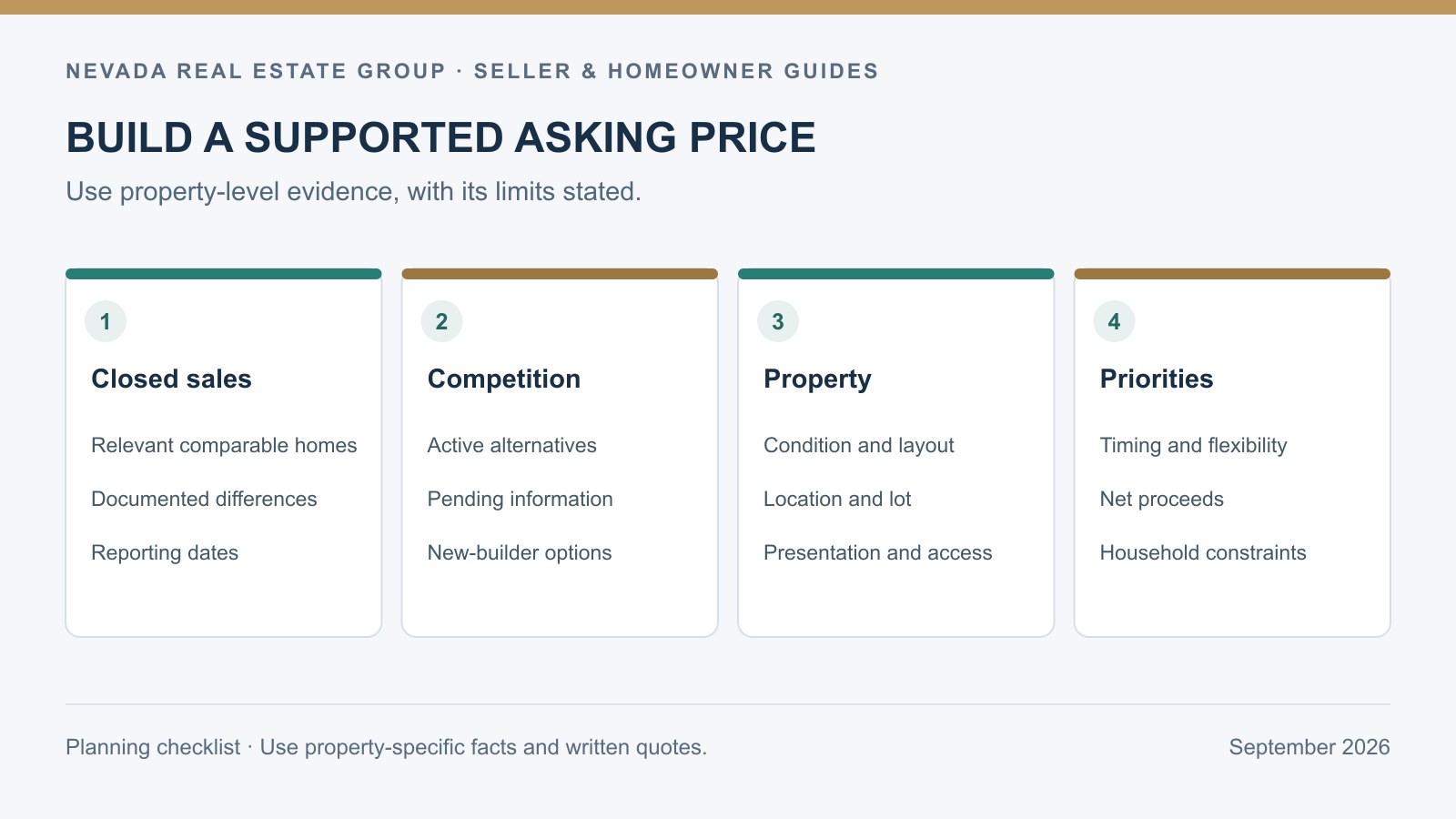
A comparative market analysis should explain why the selected properties are relevant and how their differences affect the recommendation. Start with your home: location, usable layout, size, condition, lot characteristics, parking, outdoor features, and any material limitation. Then review recent closed sales that a reasonable buyer would consider comparable. Proximity helps, but the nearest sale is not automatically the best match.
According to the Consumer Financial Protection Bureau's explanation of different property valuations, an appraisal commonly compares the property with local sales and adjusts for differences. A listing CMA is a separate professional service; it should not be represented as a lender's appraisal. The shared lesson is that differences matter, and the reasoning should be visible.
Ask why each comparable was included, which alternatives were excluded, and what the analysis cannot establish. A renovated home, a property backing to a different use, and a home with an unusually favorable lot may need different treatment. An adjustment should have a defensible basis rather than a universal dollar amount applied to every pool, view, or extra square foot.
Review active and pending properties alongside the closed sales. Active listings show what buyers can choose now, while pending listings can indicate which alternatives attracted an agreement. Their final sale prices or concessions may not yet be available. Mark those limits instead of treating an asking price as a completed transaction.
The output should be a supported range, a recommended asking strategy, and the assumptions behind it. It should also identify when the analysis needs updating. If new competition appears or a relevant pending sale closes, the evidence changes. A clear CMA gives seller and agent a shared starting point that can be questioned and revised without turning every discussion into an argument about whose opinion matters more.
How Are Asking Price, Market Value, and Seller Net Different?
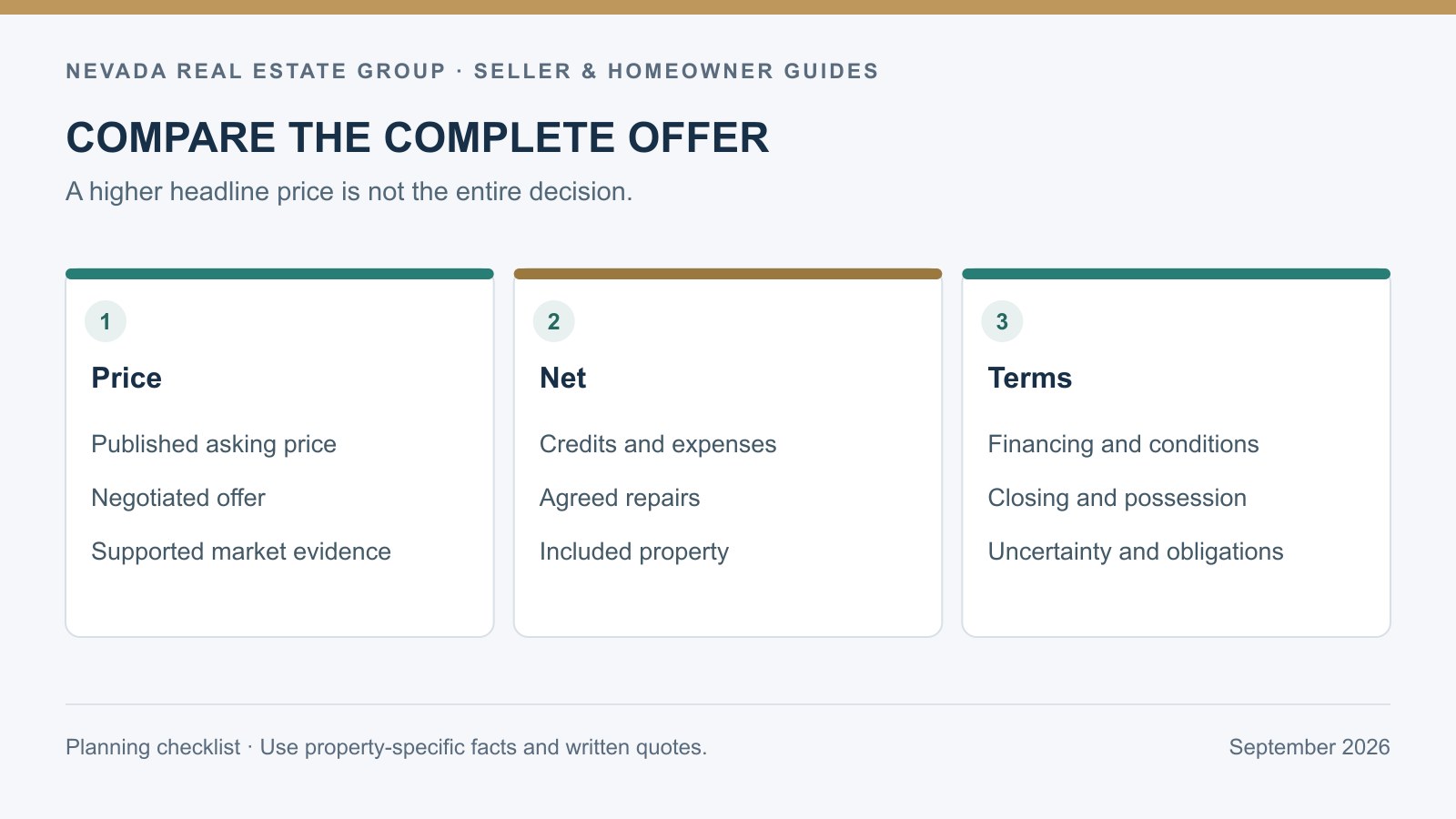
The asking price is the number published to invite offers. Market value is an assessment of what the property may trade for under relevant conditions. The eventual sale price is negotiated, and seller net proceeds depend on that price plus the transaction's costs and terms. Keeping these concepts separate prevents a high headline number from obscuring a less attractive outcome.
Your mortgage payoff, renovation spending, and next-home budget affect your financial decision, but they do not determine what buyers will pay. A seller can reasonably decide not to sell if the supported outcome does not meet their needs. That is different from assuming the market must reimburse every expense because the seller needs a particular amount.
Ask the agent to show how the proposed asking price fits both the comparable evidence and the current search landscape. Buyers may use price limits, but there is no single magic ending that guarantees more inquiries. Test likely search brackets and competing properties without abandoning the supported range merely to reach an attractive-looking number.
Compare offers using a written net sheet and the relevant terms. Credits, agreed repairs, fees, timing, contingencies, and included property can change the appeal of an offer. A lower sale price may sometimes produce a similar or better net result, but certainty and timing also have value to the household. Those tradeoffs should be explicit.
Finally, keep room for uncertainty. A recommended range is not a promise, and a list price is not evidence that the home is worth that amount. Agree on how the first weeks will be reviewed so the initial strategy can respond to market information. A pricing conversation is more productive when everyone knows which number is being discussed and what it is intended to accomplish.
Why Should Summerlin, Henderson, and North Las Vegas Be Compared Carefully?
Location matters at a finer level than a city label. A home in Summerlin should be compared with relevant alternatives within its village and competitive area, not automatically with every property carrying the master-plan name. The same principle applies across Henderson and North Las Vegas. Browse Las Vegas homes for sale for current asking-price competition, then verify the closed comparable sales separately. A citywide median combines many kinds of homes and cannot establish an adjustment for your address.
Define the buyer's practical alternatives. Consider layout, home age, finish level, lot utility, parking, community amenities, dues, and location. A single-level home may appeal differently from a similarly sized two-story property. A high-maintenance outdoor area can be a benefit to one buyer and an expense to another. The analysis should explain those distinctions instead of relying on a broad neighborhood premium.
New construction can also compete with resale. Compare the delivered home, available timing, lot, upgrades, and documented incentives rather than only a model home's advertised starting price. A builder's financing offer and a resale seller's price adjustment may affect a buyer differently. Ask the lender to evaluate the actual financing terms when that comparison matters.
Keep the sample honest when there are few close comparables. An unusual home may require a wider geography or older sales, but that should be disclosed in the reasoning. Fewer relevant observations mean more uncertainty, not permission to apply a precise universal premium.
Make a short competitor list and revisit it during the marketing period. Note which homes received reductions, went pending, returned to market, or added incentives. The list is useful because it follows the alternatives available to your buyer. It is more actionable than repeatedly checking a regional headline and assuming the same percentage change applies to every property in the valley.
What Should You Check During the First Three Days on Market?
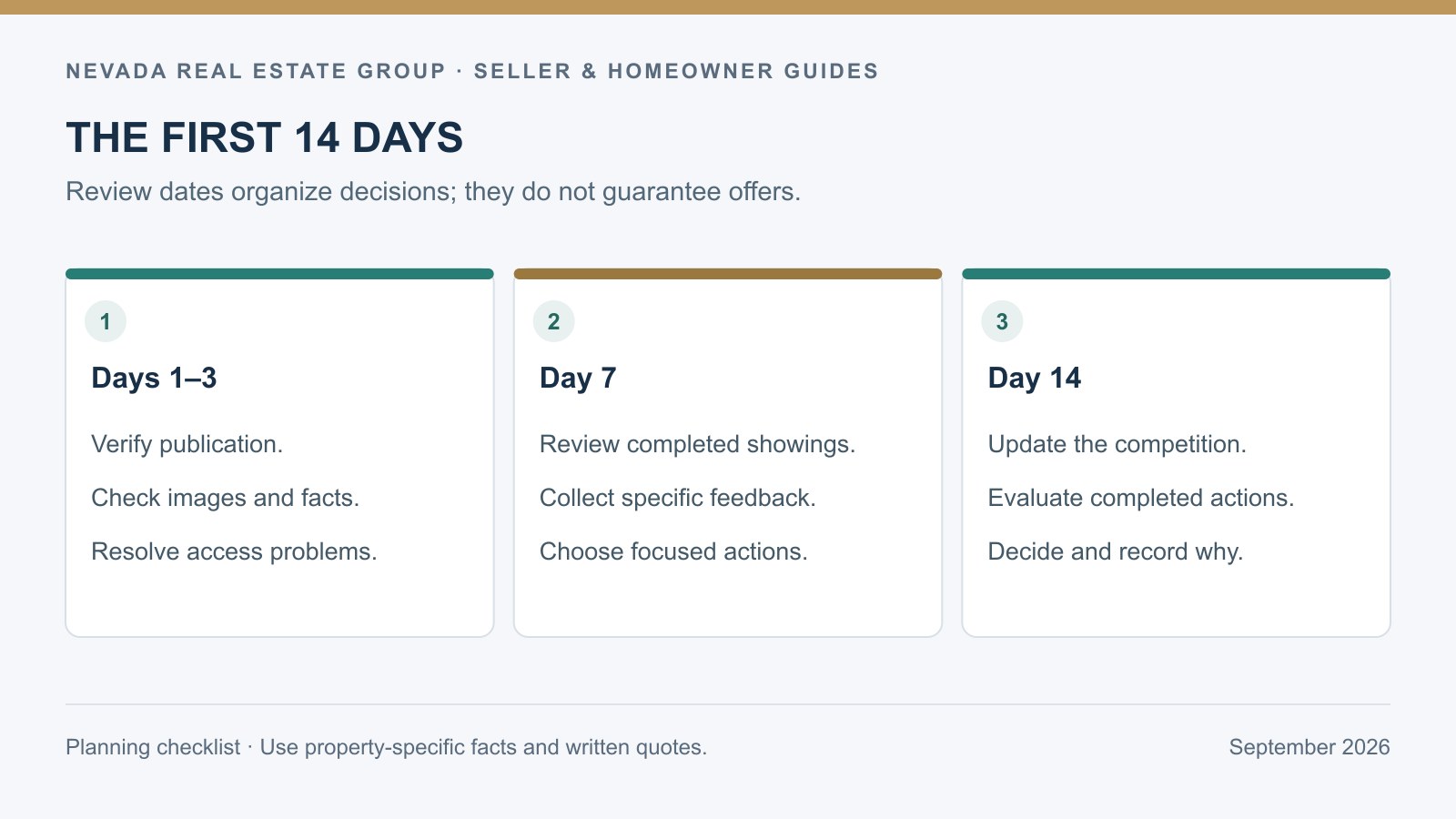
Before interpreting a quiet launch as a pricing verdict, confirm the listing actually reached buyers correctly. Review the published address, price, property type, status, photographs, room information, and showing instructions on the relevant channels. Ask the agent to resolve obvious publication or access errors promptly. A house cannot receive a fair response if prospective buyers see inaccurate information or cannot arrange a visit.
Check the presentation on a phone as well as a desktop. Are the first images clear? Is the main living space easy to understand? Do captions accurately describe the property? Does the listing contain the material information a buyer needs to decide whether to tour? A polished cover image cannot compensate for a confusing image sequence or missing practical details.
According to NAR's 2026 Code of Ethics, real estate marketing should present an accurate picture. Use that principle when reviewing photographs, descriptions, and any edited imagery. Correct an inaccurate claim rather than defending it because it appears to attract attention.
Record access problems separately from buyer rejection. A denied showing, narrow appointment window, or unanswered scheduling request is useful operational evidence, but it does not mean a buyer saw the home and rejected the price. Identify what can be improved while respecting the household's practical constraints.
Establish a simple baseline: when the listing became fully available, when showings could actually occur, and any disruption during launch. That prevents the day-seven review from comparing seven calendar days with only a few days of effective exposure. The early task is to make the listing accurate, understandable, and available, then collect evidence from real buyer activity.
What Belongs in the Day-Seven Showing Review?
The first scheduled review should bring together exposure, access, qualified inquiries, completed showings, repeat interest, feedback, and current competition. Avoid selecting one flattering metric or one discouraging comment as the whole story. A high online-view count may not translate into qualified demand, and a single showing is not a large enough sample to establish a precise price adjustment.
Ask for the difference between requested and completed showings. Review cancellations and denied requests where that information is available. Discuss whether scheduling, pets, tenant access, or preparation affected the experience. Then examine the feedback: are buyers responding to condition, layout, location, total cost, or the asking price relative to specific alternatives?
Compare activity with a relevant peer group when reliable data is available. Do not assume every listing should produce a fixed number of weekly showings. A specialized property, a particular price segment, or a constrained access schedule can have a different pattern. The comparison should be supported and specific rather than invented to create urgency.
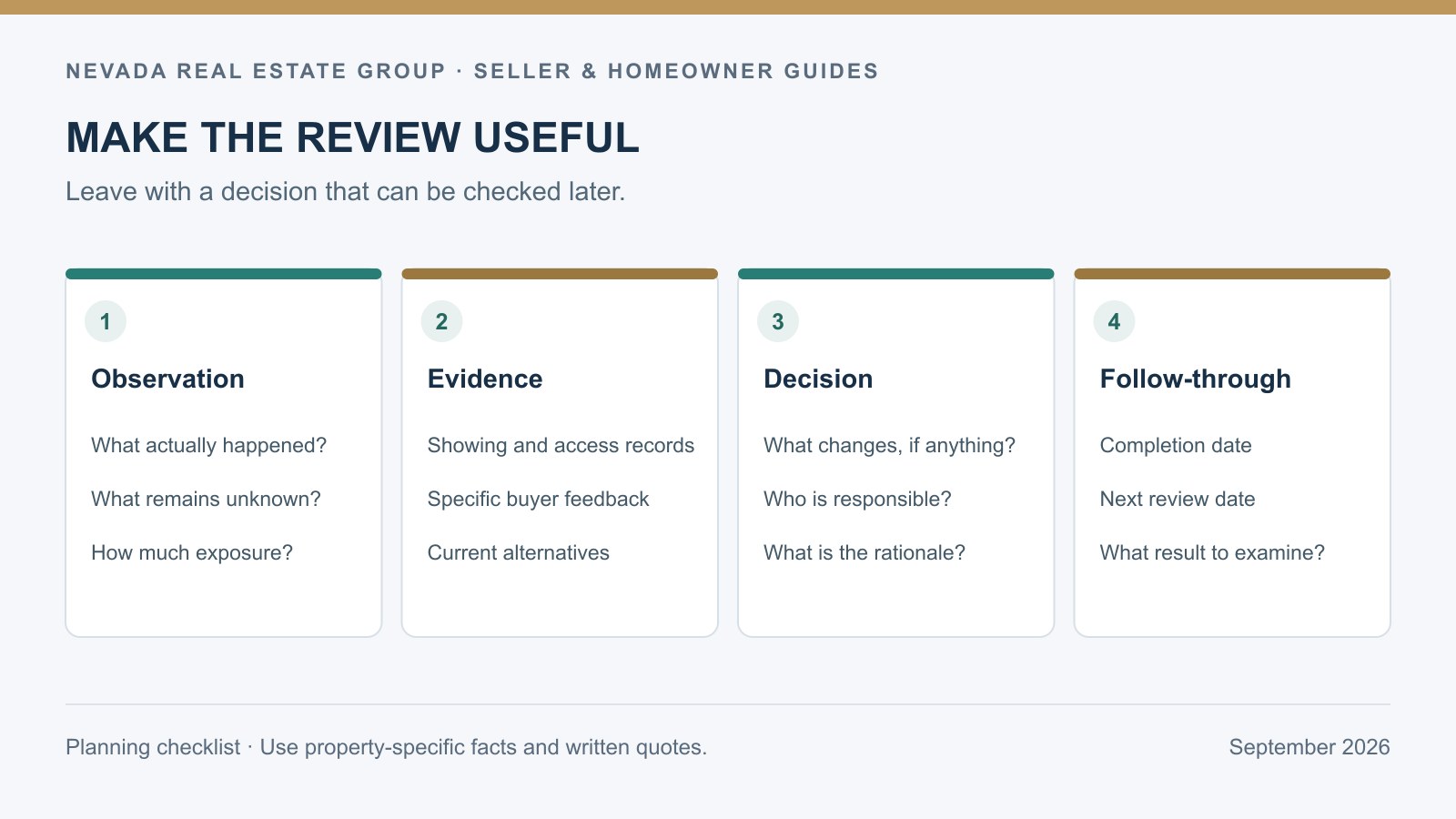
Use the meeting to choose a limited set of actions. Correct a publication problem, expand workable showing access, improve a confusing photograph, answer a recurring question, or revisit the price recommendation. Assign each action and a completion date. If nothing needs changing yet, document the reason and the next review point.
A seven-day review is a planning habit, not a sale guarantee. It creates an opportunity to notice a problem while the listing is still new to many buyers. It also helps sellers avoid the opposite mistake of changing the price immediately after one disappointing afternoon. The objective is a proportionate response to evidence, with a written record everyone can revisit at the next meeting.
How Do You Make a Useful Decision After Fourteen Days?
By the second review, compare the launch assumptions with what actually happened. Confirm that any access or presentation changes were completed and had enough exposure to be evaluated. Update the competitor list and note new closed or pending evidence. Then decide whether the current strategy remains reasonable or needs a specific change.
| Observation | Check first | Possible response |
|---|---|---|
| Few completed showings | Publication, access, audience, and close alternatives | Resolve exposure problems or reconsider positioning |
| Showings but little follow-up | Recurring objections and competing homes buyers preferred | Address supported condition, presentation, terms, or price concerns |
| Repeat interest without an offer | Unanswered questions, financing, timing, and alternatives | Clarify facts and discuss a focused negotiation approach |
| Competitors go pending | How their condition, price, and terms differ | Update the comparison and recommendation |
| No clear pattern yet | Sample size and effective exposure | Set a justified next review without inventing certainty |
Do not translate feedback directly into a mathematical discount. If several buyers mention a dated kitchen, that tells you what to investigate. It does not establish that the required reduction equals the cost of a full remodel. Compare alternatives and ask whether a modest improvement, a clarified description, negotiated terms, or a price change best addresses the concern.
Choose one coherent plan. A seller might improve access and photography immediately while scheduling a price decision after a defined additional exposure period. Another might make a supported price adjustment now because the competitive evidence is already clear. Document what changes, why, when it takes effect, and how the result will be reviewed.
The useful outcome is an informed decision, including a decision to hold when justified. Fourteen days is not a universal deadline for success or failure. It is a point at which seller and agent should be able to explain the strategy using the evidence collected, rather than repeating the original hope that the right buyer will eventually appear.
How Much Should You Reduce the Price When a Change Is Warranted?
Recalculate the supported position against today's alternatives. A meaningful adjustment is one that changes the home's competitiveness or reaches a relevant buyer search range while remaining consistent with the evidence. It is not necessarily a particular percentage. The appropriate move depends on the original price, property, competing inventory, condition, and seller priorities.
For an invented example, suppose the asking price is $620,000 and the most relevant alternatives are priced between $585,000 and $605,000. That alone does not prove the home should be reduced to a specific point. Compare condition, layout, location, concessions, and the closed-sale evidence. If the analysis supports a materially different position, explain that position and the expected tradeoffs rather than selecting a small reduction just to create an update.
Ask whether the proposed new price changes anything that matters. A minor adjustment may leave the home competing against exactly the same alternatives with the same objections. A larger adjustment can also be unjustified if it ignores a fixable exposure problem or weak comparability. Neither a sequence of small cuts nor a single dramatic cut is automatically the correct answer.
Review the seller's net and timing alongside the recommendation. Consider the consequences of continuing at the current price, making the change, or pausing the sale if that is feasible. Do not promise that a reduction will produce an offer within a fixed number of days. It changes positioning; buyer response remains uncertain.
Once approved, update all applicable channels accurately and document the rationale. Continue tracking the same measures so the next review can distinguish the effect of the change from unrelated events. A good adjustment is supported, understandable, and tied to a plan, not merely a reaction to frustration.
How Do You Tell a Pricing Problem From a Presentation Problem?
Look for evidence that separates the two, while recognizing that they can coexist. If photographs fail to explain a room or showing access is repeatedly unavailable, those are identifiable presentation or access issues. If buyers consistently prefer comparable homes offering more at the same cost, pricing or overall positioning may be involved. Avoid declaring one cause without examining the others.
Ask for specific feedback rather than a generic statement that buyers “did not love it.” Which feature concerned them? What alternative did they compare it with? Was the objection something the seller can change? A busy street, a floor-plan limitation, or a particular location is different from clutter or an inaccurate photograph. The response should fit the issue.
Condition also needs its own treatment. According to Nevada's residential disclosure law, property-condition disclosures have requirements and exceptions that should be addressed in the transaction. A cosmetic improvement does not eliminate the need to handle known information accurately. Use the appropriate professionals to investigate and document concerns rather than staging around them.
If preparation work is being considered, our home-improvement guide for Las Vegas sellers helps separate repairs, refresh work, and optional renovations. Obtain a scope and budget before assuming construction is a better answer than changing price or terms. A long project can affect the listing timeline and household plans.
Finally, avoid collecting endless feedback without making decisions. Once there is a consistent, well-supported pattern, document the available responses and choose one. A clear diagnosis reduces wasted spending and helps the seller understand why the recommended action addresses the observed problem rather than simply following a familiar sales script.
How Do a Price Cut, Closing Credit, and Rate Buydown Compare?
Choose the term that addresses the buyer's actual constraint, then compare the seller's proceeds and remaining obligations. A price cut reduces the contract price. An eligible closing-cost credit can reduce approved cash expenses at closing. A temporary buydown subsidizes scheduled payments for a limited period, while permanent discount points purchase a lender-quoted rate adjustment. These are different outcomes even when a seller budgets the same amount.
The table is a hypothetical comparison prepared in October 2026, not a lender offer or reported sale. Assume an initial $500,000 price and a $10,000 seller concession budget. The last column subtracts only the named concession; it is not seller net proceeds. Commissions, taxes, other fees, payoff, prorations, and additional obligations still require an actual net sheet, and price-based costs can differ between options.
| Option | Contract price | Named concession | Buyer benefit to verify | Price less named concession only |
|---|---|---|---|---|
| Price reduction | $490,000 | No separate credit | Lower price; recalculate loan and down payment | $490,000 |
| Closing-cost credit | $500,000 | Up to $10,000, if allowed and usable | Approved closing expenses; not unrestricted cash | $490,000 if all $10,000 is used |
| Temporary buydown | $500,000 | Up to $10,000 toward an approved plan | Quoted subsidy, payment schedule, and full later payment | $490,000 if all $10,000 is used |
| Permanent discount points | $500,000 | Up to $10,000, subject to quote and limits | Quoted rate change, costs, and payment comparison | $490,000 if all $10,000 is used |
According to Fannie Mae's interested-party-contribution guidance, eligible seller contributions have limits and cannot fund the buyer's down payment or reserves; seller-funded buydowns count toward the applicable limits. These are Fannie Mae rules, not a promise about every FHA, VA, jumbo, or other loan. Have the actual lender confirm the program, property use, loan-to-value calculation, eligible costs, maximum usable contribution, and treatment of any unused amount before negotiating.
According to Fannie Mae's temporary-buydown guidance, the borrower is qualified at the note rate and the buydown agreement does not change the mortgage note. Request the full payment schedule, including the payment after the subsidy ends. Do not assume a particular seller budget buys a 2-1 plan or that refinancing will be available before the higher payment begins.
According to the CFPB's explanation of discount points, a point is 1% of the loan amount, but its rate reduction depends on the lender and loan. A dollar budget alone therefore cannot establish the permanent payment savings. Compare written quotes with consistent loan amount, term, lock assumptions, and all costs; an illustrative rate is not a current offer.
Download the blank seller-concession worksheet and complete the same rows for each offer: contract price, concession actually used, other selling costs, debt payoff, estimated seller net, buyer cash to close, payment schedule, contingencies, and closing date. Ask the closing professional to prepare the final net comparison. According to the CFPB's Closing Disclosure guide, the seller-credit entry should match the agreement. Resolve differences before signing.
If a condition issue is driving the negotiation, also verify whether the lender or insurer requires work before closing. Our Kitec plumbing records guide illustrates why a credit and a completed repair are different decisions. A financially attractive offer still needs workable condition, timing, and underwriting terms.
Does Withdrawing or Relisting Erase the Home's History?
Do not assume it does. A new marketing attempt can introduce different photographs, an improved condition, better access, revised terms, or a new price. Those changes may matter to buyers. Simply taking a property off the market and returning later does not guarantee that previous prices, photographs, or listing history disappear from every system or from buyers' memories.
Ask the listing broker to explain the current MLS rules that apply to status changes, days on market, cumulative history, and any new listing entry. Those definitions are not interchangeable across systems. A portal display is also not necessarily a complete account of the property's marketing history. Avoid promising a universal reset after a specific number of days away.
If a listing expires or is withdrawn, conduct a review before relaunch. Was the price supported? Could buyers arrange showings? Did the photographs match the home? Were relevant condition concerns addressed? Did the property compete with newly available homes or builder incentives that were missing from the original analysis? The answers should shape the new plan.
According to NAR's Code of Ethics, marketing representations must be truthful. Present a relaunch as what has actually changed. Fresh photographs or completed work can be described accurately without implying a history that the property does not have.
A pause can still be reasonable for household timing, access, repairs, or a reconsidered sale decision. Price that pause honestly, including carrying expenses and any overlap with another move. Relaunch when there is a coherent reason and a supported plan, not because a calendar interval is assumed to make the prior experience irrelevant.
How Should Carrying Costs Influence Your Decision to Wait?
Use your actual monthly expenses, not a generic number attached to the home's value. Identify mortgage cash payments, taxes, insurance, association dues, utilities, maintenance, and any additional costs created by the move. Separate fixed obligations from costs that would change if the home sold. Principal repayment and equity also deserve separate treatment when evaluating the broader financial outcome.
For a simple invented cash-flow illustration, an additional $3,000 per month of ongoing payments over two months totals $6,000. That arithmetic does not prove accepting any offer $6,000 lower is better. The offer may close on a different date, carry different costs, or have different risks. It shows why time belongs in the comparison rather than being treated as free.
Run scenarios with a realistic closing schedule and a less convenient one. Include a possible delay, continued maintenance, and any overlapping housing costs. Ask whether the household has enough reserve to remain comfortable if the preferred timeline does not occur. The goal is to understand the tradeoffs before a difficult offer arrives.
Do not use carrying-cost pressure to justify an unsupported valuation. According to the CFPB's explanation of valuation methods, different approaches can produce different property values. Your expense ledger is another kind of information: it helps determine your willingness to wait, not the buyer's assessment of the home.
Discuss the choices in plain terms. What is the supported price range? What does another month cost the household? Which terms would make a sale workable? When would pausing be preferable? A seller who understands those questions can make a deliberate decision without relying on promises that patience always produces a higher net result.
How Can NREG Help Build and Review Your Pricing Plan?
A useful pricing consultation begins with the property and your priorities. Bring the address, condition information, recent work, desired timing, and any constraints on showings or moving. We can discuss the relevant comparable properties, current competition, and a review schedule. Ask for the rationale in writing so the recommendation can be evaluated and revisited as evidence changes.
At Nevada Real Estate Group, our team of 150+ Nevada-licensed agents includes dedicated specialists for Summerlin, Henderson, North Las Vegas, and the luxury communities corridor. Per RealTrends 2025 rankings, our team ranks among the top 100 real estate teams nationwide.
NREG Career + 2025 Production Track Record
| Metric | Career Cumulative | 2025 Single Year |
|---|---|---|
| Closed transactions | 9,600+ | 789 |
| Closed sales volume | $4.85B+ | $361.5M+ |
| 5-star verified reviews | 9,097+ (Google + Zillow + FastExpert combined) | 1,200+ added in 2025 |
| Licensed agents on team | 150+ | 150+ |
| Years operating in Nevada | 16+ | 16+ |
| Industry rank | #1 Team in Nevada (RealTrends) | #1 Las Vegas FastExpert |
The selling plan should identify responsibilities for preparation, photographs, showing access, feedback collection, and the day-seven and day-fourteen meetings. It should also make room for the seller to question an assumption or decline a proposed change. A clear process helps both parties distinguish a new fact from a repeated opinion.
Review our seller resources and 7-day listing agreement for the service and agreement discussion. Read the actual agreement for its terms; a marketing review date is not itself a contractual guarantee. Keep service commitments, pricing recommendations, and market outcomes distinct.
To discuss your property's plan, call (702) 637-1759 or contact us. The objective is a supported launch and a disciplined response to what buyers actually do, with accurate information and decisions you understand throughout the process.
Frequently Asked Questions
How do I know whether my Las Vegas home is priced correctly?
Review comparable closed sales, current alternatives, property condition, and actual buyer responses. Confirm that the listing is accurate and accessible before interpreting a low showing count. A supported asking price should have a clear rationale, but no fixed number of showings or days guarantees that the initial recommendation is correct.
Should I automatically reduce the price after fourteen days?
No. Use fourteen days as a scheduled decision point. Examine effective exposure, access, completed showings, recurring feedback, and new competition. A price change may be justified, or another issue may need correction first. Document the evidence, chosen action, and next review date rather than following an automatic percentage rule.
How large should a price reduction be?
Base it on the home's supported competitive position, not a universal percentage. Ask whether the proposed adjustment meaningfully changes the alternatives buyers compare or the relevant search range. Review condition, concessions, and seller net as well. Neither a token reduction nor a dramatic cut is automatically appropriate for every listing.
What was the Las Vegas median sale price in the latest report used here?
LVR reported a $475,000 median for existing single-family homes sold through its Southern Nevada MLS in August 2026. That regional figure is context, not a valuation for a particular home or neighborhood. Use property-specific comparable sales and current competition to make a listing decision, and keep the reporting month attached to the statistic.
Does relisting a home reset its history?
Do not assume previous prices or marketing history disappear. Ask the broker about current MLS status and days-on-market rules, and recognize that portals may display history differently. A relaunch is stronger when something material has improved, such as condition, photographs, access, terms, or supported pricing. Present those changes accurately.
Is an automated home value the same as an appraisal or CMA?
No. Automated estimates, a listing professional's comparative market analysis, and a lender's appraisal are different methods and services. They may use different information and produce different results. Ask how the property's condition and specific comparables were evaluated. Use the appropriate analysis for the decision rather than treating every displayed value as interchangeable.
Is the highest offer always the best offer for the seller?
No. Compare seller credits, other costs, financing, contingencies, timing, and obligations as well as price. Use a consistent net sheet and discuss uncertainty with the transaction professionals. A higher headline price can come with terms that reduce net proceeds or make the transaction less suitable for the household's priorities.
Which Sources Inform This Pricing Playbook?
Market data below cover August 2026. The October 18, 2026 review rechecked those historical figures and the new concession guidance; the market period remains August 2026. The review calendar, decision tables, and invented examples are editorial tools, not measured promises of showing activity or sale speed.
- LVR August 2026 release distributed by B&P, carried by Nevada Business
- CFPB: why property valuations differ
- Fannie Mae: interested-party contributions
- Fannie Mae: temporary interest-rate buydowns
- CFPB: discount points and lender credits
- CFPB: Closing Disclosure guide
- NAR: 2026 Code of Ethics
- Nevada Legislature: residential disclosure provisions in NRS Chapter 113
Chris Nevada · Nevada Real Estate License S.181401 · Nevada Real Estate Group · LPT Realty · 8945 W Russell Rd, Suite 170 · Las Vegas, NV 89148 · (702) 637-1759 · License verifiable at red.nv.gov.